


Gentle and Efficient: Intelligent Control for Underfloor Heating
The comfortable experience of "warm feet, cool head" provided by underfloor heating is gaining favor among an increasing number of households. However, in actual use, many users often encounter three typical pain points: slow warm-up, delayed response, and high energy consumption. Underfloor heating systems always seem to be a step behind-after manually turning up the temperature, it takes two or three hours before you can feel the difference; if the system is turned off during the day while no one is at home, users must endure a cold floor for a long time when they return in the evening; yet if the system runs all day, the high gas or electricity bill becomes a real concern.
The root cause of these problems lies in the unique physical characteristic of underfloor heating: thermal inertia. As long as the correct control logic is mastered, underfloor heating can be made both gentle and highly efficient. The key is to choose a room thermostat that truly understands underfloor heating.
I. Core Principle: Understand "Thermal Inertia" and Use Intelligent Control to Resolve Lag
The heating layer of an underfloor heating system is usually embedded in concrete, cement mortar, or a leveling layer. This medium has a very large heat capacity. When the heating system starts, the heat must first warm this layer before it can be transferred to the floor surface and indoor air. Likewise, after the system is turned off, the heat stored in the medium continues to be released. This is the "thermal inertia" of underfloor heating: it warms up slowly and cools down slowly as well.
Traditional manual control or simple timer switching works against this inertia. Users switch the heating on only after they feel cold, but by the time the temperature rises, they have already been cold for a long time. They switch it off only after they feel hot, and the residual heat then causes the room to overheat. This delayed response leads to frequent overheating and unnecessary energy consumption.
The core strategy of intelligent control is: advanced programming + closed-loop temperature feedback.
-
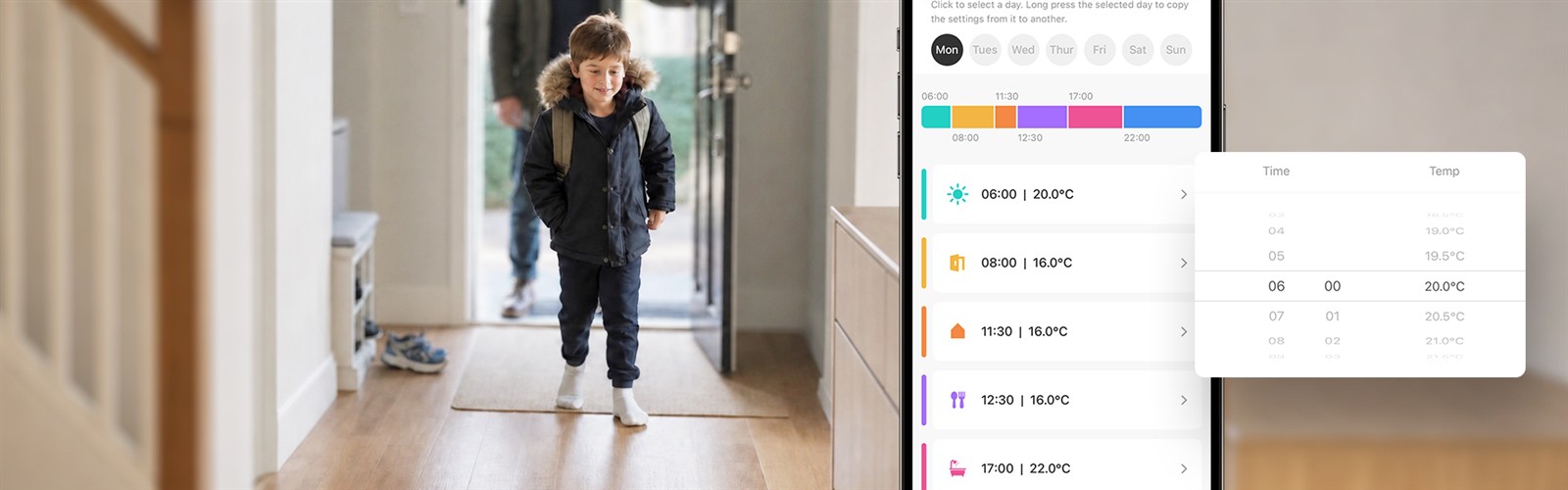
Advance programming: Based on your daily routine, the heating system automatically starts heating in advance. For example, if you set the room temperature to reach 20°C by 7:00 a.m., the controller will calculate the warm-up delay of the underfloor heating system, usually 2–3 hours, and automatically start heating at around 4:30 or 5:00 a.m. This means the floor is already warm when you step on it, with no waiting required.
-
Closed-loop temperature feedback: Working with both an indoor air sensor and a floor sensor, the system monitors the difference between the actual temperature and the target value in real time. As the temperature approaches the target, the intelligent algorithm automatically reduces heating power or adjusts the opening of the water valve to prevent temperature overshoot. When residual heat causes the temperature to exceed the target, heating is stopped promptly. This feedback control system can keep temperature fluctuations within ±0.5°C, ensuring both comfort and energy efficiency.
This is exactly the core capability of our "Smart Warm Series Underfloor Heating Room Thermostat": it features a built-in high-precision PID control algorithm, automatically learns the thermal inertia characteristics of your underfloor heating system, and provides the optimal advance start time and power adjustment strategy. You simply set the desired temperature and time, and leave the rest to the thermostat.
II. Zone Management: Customize Independent Temperature Curves for Each Area
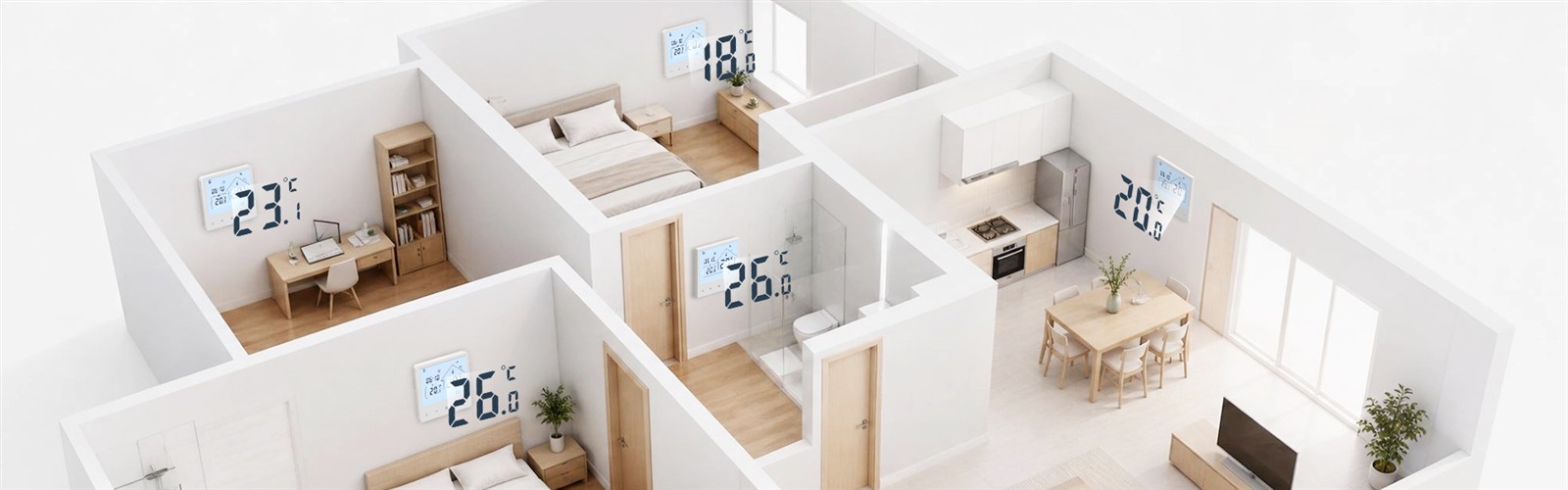
Different rooms have very different usage patterns and temperature requirements. Using a single setting for the whole house inevitably leads to waste or discomfort. Intelligent zone control can easily solve this problem:
-
Living room: As the main activity area, it can maintain an energy-saving base temperature of 18–19°C during the day, then automatically rise to 21–22°C before family members return home in the evening. During the late-night hours when no one is active, the temperature drops back down to 17–18°C for thermal maintenance.
-
Bathroom: The bathroom needs to be warmer than other rooms, especially during morning showers. You can set timed morning preheating-For example, starting at 6:30, the bathroom floor heating temperature is raised from 16°C at night to 24°C. By 7:00 a.m., when you use the bathroom, the floor is already warm and dry, and even towels and slippers feel warm. After use, the temperature automatically drops back to 18°C.
-
Bedroom: A high temperature is not actually needed during sleep (16–18°C is more suitable for sleeping). However, the room can briefly warm up to 20°C half an hour before you get up, making it much more comfortable to step out of bed.
-
Infrequently used rooms, such as guest rooms and storage rooms: Keep them in a low-temperature anti-freeze mode of 5–10°C, and heat them temporarily only when needed.
By setting independent weekly programmed temperature curves for each room or zone, with different schedules for weekdays and weekends and multiple time periods within a day, the underfloor heating system heats the right space at the right time and avoids unnecessary whole-house operation. Practical cases show that scientific zone management can save 20%–35% of energy consumption.
Our room thermostat fully supports independent multi-zone control --- Each thermostat manages one room, and the mobile app allows you to set independent weekly programming curves for the living room, bathroom, and bedroom without interfering with one another. Set it once, and it runs automatically.
III. Energy-Saving Tips: Two Sensors Control More Accurate
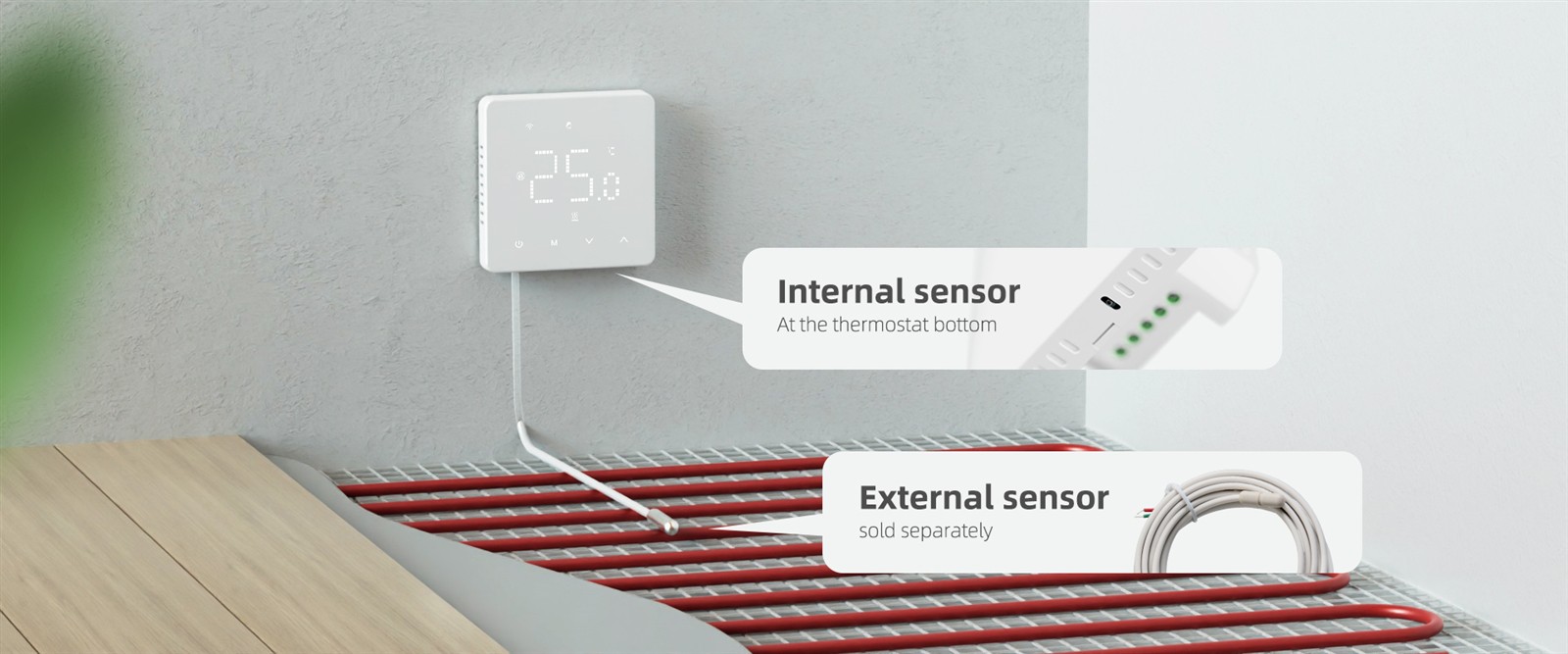
In addition to zoning and programming, truly advanced energy savings come from more refined sensing and control logic. Two key functions are recommended:
1. Floor Sensor - Prevents Overheating
Many thermostats rely only on indoor air temperature for control. However, a key characteristic of underfloor heating is that the floor temperature is often higher than the air temperature. If control is based only on air temperature, it is easy for the floor to become overheated (above 29°C and making it feel too hot underfoot and wasting energy), while the air temperature still has not reached the set point.
The floor sensor directly monitors the actual temperature of the floor surface or the backfill layer. The intelligent controller can dynamically adjust heating output according to the relationship between the floor temperature and the set upper limit (such as 27°C). When the floor temperature approaches the limit, the system actively reduces power even if the air temperature has not yet reached the set point---because the heat stored in the floor will continue to radiate upward and the air temperature will naturally rise over the next half hour. This control method avoids meaningless full-power heating, and protects floor materials, also can saves more than 15% of energy.
The "Floor Heating Series" room thermostat comes standard with a floor temperature sensor interface and built-in floor temperature limit protection logic. You can set the maximum floor temperature, such as 26°C, and the thermostat will prioritize preventing floor overheating while also meeting room temperature requirements. It is compatible with both hydronic and electric underfloor heating systems.
2. 0.5°C High-Precision Temperature Control - Eliminate Waste and Improve Comfort
Traditional thermostats or mechanical switches often offer temperature control accuracy of only ±1°C or even ±2°C. This means that when the set point is 20°C, the actual room temperature may fluctuate widely between 18.5°C and 21.5°C. To prevent the temperature from falling to the "cold" side, the system must frequently overheat, resulting in significant energy waste. At the same time, an environment that swings between hot and cold feels uncomfortable.
Temperature control accuracy of 0.5°C is completely different. Our room thermostat uses high-precision sensors and an advanced PID algorithm to keep the actual room temperature stable within ±0.5°C of the set value. For example, when set to 20°C, the room temperature will remain between 19.5°C and 20.5°C.
Why does this save energy?
-
It eliminates the redundant energy consumption caused by "overheating to prevent overcooling." With traditional ±1°C control, you need to raise the set point by 1°C to ensure the lowest temperature does not feel cold, which is already a waste.
-
Precise temperature control prevents large residual heat losses after temperature overshoot. When underfloor heating exceeds the target by 1°C due to inertia, all the extra heat released is lost through walls and windows, resulting in unnecessary waste.
-
Actual tests show that improving temperature control accuracy from ±1°C to ±0.5°C can further save 10%–15% of heating energy while significantly improving perceived comfort-no more waking up feeling hot one moment and cold the next.
The "Smart Warm Series" room thermostat is factory-calibrated to a temperature control accuracy of ±0.5°C. When used in conjunction with floor sensors, it delivers a consistent, uniform temperature experience throughout the entire home.
IV. Why Choose the Smart Warm Series Underfloor Heating Room Thermostat?
Integrating all of the above functions into a small wall-mounted thermostat is not simple. Our room thermostat is specially optimized for underfloor heating systems. Compared with general-purpose thermostats or ordinary timer switches, it provides:
✅ Self-learning PID algorithm: adapts to different home insulation conditions and underfloor heating types, including hydronic, electric, and dry underfloor heating
✅ Daily programming: up to 6 time periods per day, with each day set independently
✅ Floor sensor interface + temperature limit protection: prevents floor overheating for safety and comfort
✅ ±0.5°C high-precision temperature control: eliminates hot-and-cold fluctuations and prevents waste from overheating
✅ Mobile app remote control: enable energy-saving mode when leaving home and preheat remotely before returning
✅ Energy consumption statistics report: clearly view daily heating duration and estimated energy consumption to help optimize your settings
V. Conclusion: Gentle and Efficient Can Go Hand in Hand
The thermal inertia of underfloor heating is not a defect; it simply requires the right control philosophy-a shift from "passive response" to "active prediction." Through advance programming, independent zone management, a floor temperature sensor, and ±0.5°C high-precision temperature control, you can achieve:
✅ The floor is already warm when you get up, and the room is already comfortable when you return home
✅ Temperature remains stable without oscillation, with no hot-and-cold fluctuations
✅ Overall energy consumption is reduced by 30%–50%, delivering considerable cost savings
The starting point for all of this is replacing the ordinary switches or old thermostats in each room with a room thermostat that truly understands underfloor heating.
The "Smart Warm Series Underfloor Heating Room Thermostat" is now available. Click the button below to get a customized energy-saving solution for your home layout, or consult our engineers on how to achieve whole-home zone control with the fewest thermostats.
Underfloor Heating Room Thermostat

Electric Underfloor Heating Room Thermostat
Used to control 16A electric underfloor heating devices, such as heating films, heating mats, heating cables, etc....

Water Underfloor Heating Room Thermostat
Used to control 3A water underfloor heating devices, such as motorized valve acatuors, manifold thermal actuators, etc...