


Common Thermostat Wiring Configurations for HVAC and Boiler Systems
Jul 03, 2026
As heating and cooling systems become more advanced, understanding thermostat wiring is increasingly important for installers, distributors, and building professionals. Whether you are working with a residential boiler, underfloor heating system, heat pump, or HVAC equipment, selecting the correct wiring configuration ensures reliable operation and optimal energy efficiency.
A Smart Room Thermostat can only perform as intended when it is properly matched with the heating or cooling equipment it controls. Incorrect wiring may lead to communication failures, unstable temperature control, or even equipment damage. In this guide, we will explore the most common thermostat wiring configurations used in European HVAC and boiler systems and explain how to choose the right solution for different applications.
Why Thermostat Wiring Matters
The thermostat acts as the control center of a heating or cooling system. It monitors room temperature and sends signals to boilers, valves, pumps, actuators, or HVAC equipment.
Different systems require different control methods. For example:
A gas boiler may use a simple relay contact.
A modern condensing boiler may support OpenTherm communication.
Electric underfloor heating systems often require direct load switching.
HVAC systems may use heating and cooling outputs simultaneously.
Understanding these differences helps installers avoid compatibility issues and ensures the thermostat can fully utilize the capabilities of the connected equipment.
Dry Contact (Volt-Free) Wiring Configuration
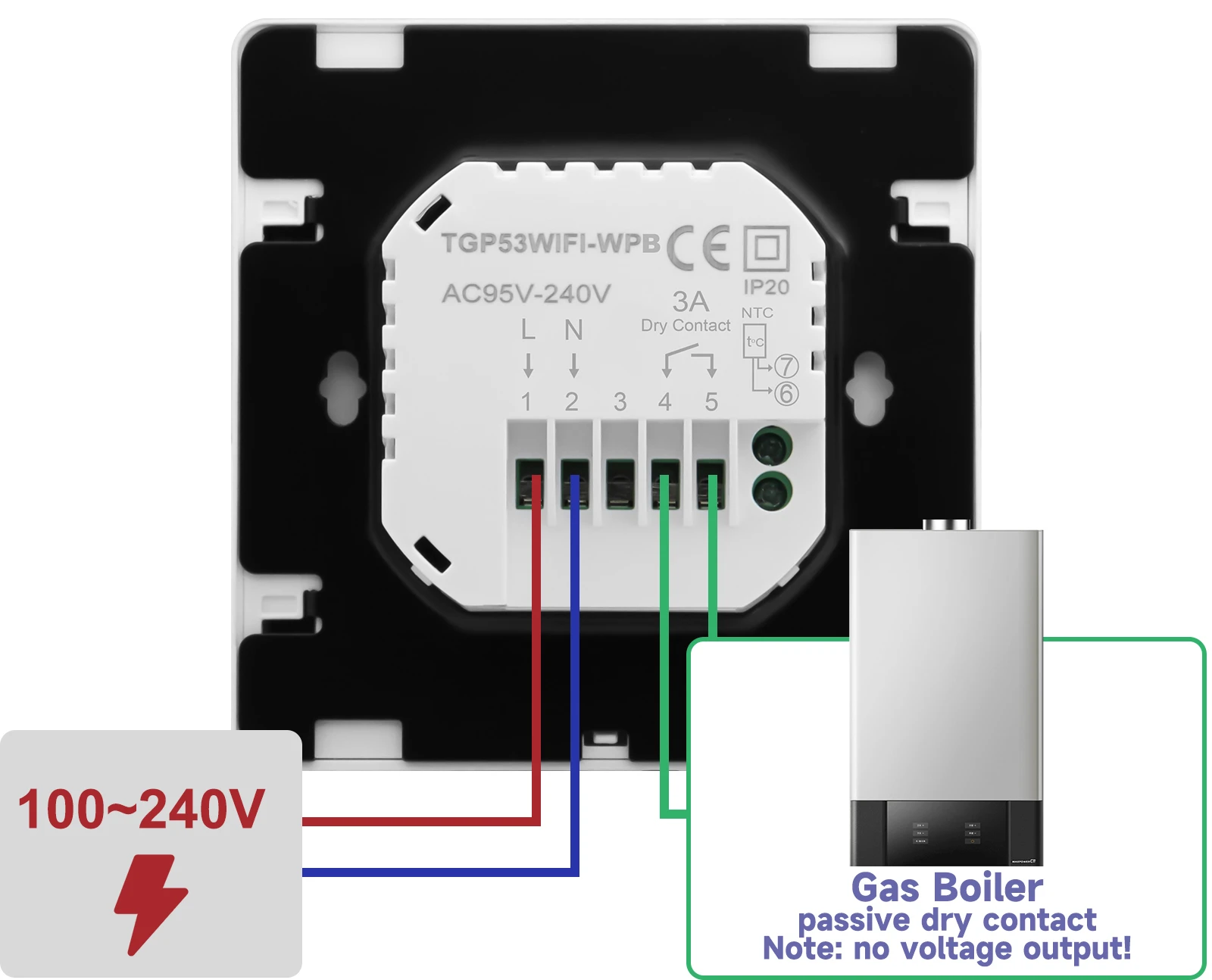
One of the most common wiring methods in Europe is the dry contact output, sometimes referred to as a volt-free contact.
In this configuration, the thermostat acts like a switch. When heating is required, the contact closes and sends a signal to the boiler or heating controller. When the desired temperature is reached, the contact opens and stops the heating demand.
Typical Applications
Gas boilers
Oil boilers
Pellet boilers
Heat pumps
Zone valve control systems
Advantages
Broad compatibility
Simple installation
Reliable operation
Suitable for retrofit projects
Many installers prefer dry contact wiring because it works with a wide range of heating systems from different manufacturers. A Smart Room Thermostat with dry contact output is often the safest choice when compatibility information is limited.
230V Relay Wiring Configuration
Some heating systems require the thermostat to switch mains voltage directly. In these installations, the thermostat provides a 230V output to control actuators, circulation pumps, or electric heating equipment.
Typical Applications
Water underfloor heating actuators
Zone valves
Electric boilers
Fan coil systems
Heating manifolds
Advantages
Direct equipment control
Reduced need for external relays
Widely used in European residential projects
Important Considerations
Because mains voltage is involved, proper installation practices are essential. Wiring should always comply with local electrical regulations and be performed by qualified personnel.
Many modern thermostat manufacturers offer models specifically designed for 230V switching applications to simplify installation and improve reliability.
OpenTherm Communication Wiring
OpenTherm has become increasingly popular across Europe, especially with high-efficiency condensing boilers.
Unlike traditional on/off control, OpenTherm allows continuous communication between the thermostat and the boiler.
Instead of simply telling the boiler to start or stop, the thermostat can request specific heating outputs based on room conditions.
Benefits of OpenTherm
Improved energy efficiency
More stable room temperature
Reduced boiler cycling
Lower fuel consumption
Enhanced system diagnostics
Typical Applications
Condensing gas boilers
Modern energy-efficient heating systems
Smart home integrations
A Smart Room Thermostat equipped with OpenTherm communication can help homeowners achieve greater comfort while reducing energy costs, making it an increasingly attractive option throughout Europe.
Electric Underfloor Heating Wiring
Electric underfloor heating systems require a different wiring approach because the thermostat directly controls the heating load.
In these systems, the thermostat usually receives:
Power supply
Heating cable connection
Floor temperature sensor connection
The floor sensor plays a critical role in protecting the floor covering from overheating while maintaining user comfort.
Advantages
Precise temperature control
Improved comfort
Better protection for floor materials
Suitable for bathrooms, kitchens, and living areas
Many European households choose electric underfloor heating because it offers uniform heat distribution and easy installation in renovation projects.
Heating and Cooling Thermostat Wiring
In commercial buildings and modern residential projects, a single thermostat may control both heating and cooling functions.
These systems often require separate outputs for:
Heating demand
Cooling demand
Fan control
Valve control
Typical Applications
Fan coil units
Heat pump systems
Central HVAC systems
Commercial buildings
The wiring configuration depends on the specific equipment and control requirements.
As building automation becomes more common, advanced thermostat solutions are increasingly expected to support multiple operating modes within a single device.
Multi-Zone Heating Wiring
Multi-zone heating has become a popular solution for improving comfort and energy efficiency.
Instead of heating the entire building to the same temperature, each zone can be controlled independently.
Typical Components
Smart thermostats
Wiring center
Thermal actuators
Zone valves
Boiler controller
Benefits
Reduced energy consumption
Improved comfort
Flexible scheduling
Individual room control
A properly configured Smart Room Thermostat allows occupants to customize temperatures in different rooms while minimizing unnecessary heating.
Common Wiring Mistakes to Avoid
Even experienced installers occasionally encounter wiring-related issues.
Some of the most common mistakes include:
Choosing the Wrong Thermostat Type
A thermostat designed for electric heating may not be suitable for a boiler application, and vice versa.
Ignoring Voltage Requirements
Always verify whether the controlled equipment requires dry contact or voltage output.
Incorrect Sensor Installation
Floor sensors should be installed in the correct position to ensure accurate temperature measurement.
Poor Cable Management
Loose connections and poorly organized wiring can create reliability issues and make future maintenance more difficult.
Overlooking Communication Protocols
When working with OpenTherm systems, ensure both the boiler and thermostat support the protocol.
Selecting the Right Thermostat for Your Project
The ideal thermostat depends on several factors:
Heating system type
Voltage requirements
Communication protocol
Energy-saving goals
User interface preferences
Smart home integration requirements
For distributors and HVAC professionals, choosing a flexible thermostat platform can simplify inventory management and improve project compatibility.
BEOK Controls offers a wide range of thermostat solutions for boilers, underfloor heating systems, heat pumps, fan coil units, and HVAC applications. With support for relay control, dry contact outputs, Wi-Fi connectivity, and OpenTherm communication, BEOK products are designed to meet the evolving needs of European heating markets.
Conclusion
Thermostat wiring is more than a technical detail-it is the foundation of reliable temperature control and energy-efficient system operation.
From traditional dry contact boilers to advanced OpenTherm systems and multi-zone HVAC installations, each application requires the correct wiring configuration to achieve optimal performance.
As demand for intelligent climate control continues to grow across Europe, selecting the right Smart Room Thermostat and understanding its wiring requirements will remain essential for installers, distributors, and end users alike.
Whether you are upgrading an existing heating system or designing a new energy-efficient building, investing time in proper thermostat selection and wiring will deliver long-term benefits in comfort, efficiency, and reliability. For professionals seeking dependable and innovative thermostat solutions, BEOK Controls continues to support projects with products tailored to modern HVAC and boiler applications.
You Might Also Like
-

White Screen 2 Pipe and 4 Pipe Fan Coil Thermostat TDS21-AC
-

OLED Screen Display Wi-Fi Radiator Actuator TRV-604
-
Piano Buttons Floor Heating WIFI Thermostat TGP53
-
Black Round Screen Wifi Radiator Control Actuator TRV-705WF
-
RF Wireless Gas Boiler Heating Thermostat BOT-R8X-WIFI
-

RZ-AK 230V Normally Closed Thermal Actuator For Underfloo...