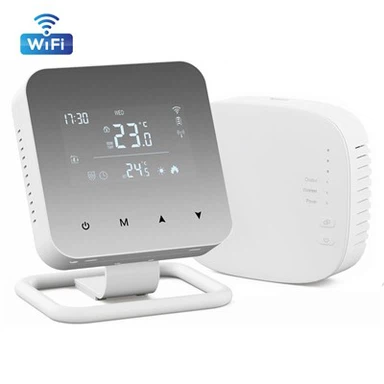


How should the installation location for the underfloor heating control box be selected?
Aug 06, 2026
The underfloor heating control box is a core component of the zoning control system; it primarily receives control signals from room thermostats and drives the thermoelectric actuators on the manifold. Additionally, some control boxes can coordinate the operation of circulation pumps, boilers, heat pumps, or motorized valves for district heating.
Although the function of the control box is straightforward, its installation location directly impacts wiring costs, wireless communication stability, ease of future maintenance, and system operational safety.
An improper installation location can lead to issues such as excessively long actuator wiring, unstable wireless thermostat communication, moisture ingress in the junction box, insufficient space for servicing, and even damage caused by overheating or water exposure.
So, where should the underfloor heating control box be installed, and what factors need to be considered during installation?
Ⅰ. Where is the underfloor heating control box usually installed?
In most residential underfloor heating systems, the control box is typically installed near the manifold assembly.
This is because the control box must connect to multiple thermoelectric actuators mounted on the manifold. Installing the control box close to the manifold shortens actuator power cables and reduces wiring clutter, while also making it easier for installers to handle wiring, commissioning, and troubleshooting.
Common installation locations include:
Inside the manifold cabinet;
Above or to the side of the manifold cabinet;
On the wall of the boiler room or utility room;
Inside a dedicated floor-level heating control cabinet;
Inside a separate low-voltage or control box near the manifold.
For single-story homes with only one manifold assembly, a single control box installed near the manifold is usually sufficient.
For duplexes, townhouses, or multi-story villas with independent manifolds on each floor, it is generally recommended to install a separate control box for each floor, rather than routing actuator wiring from all floors to a single central control box.
Ⅱ. Why should the control box be close to the water collector?
The control box is installed close to the water collector and has the following main advantages.
1. Shorten the actuator wiring distance
Thermoelectric actuators are usually installed directly on the manifold return valve, and each actuator needs to be connected to the corresponding output of the control box.
If the control box is too far from the manifold, longer wires will need to be laid for each actuator. For an 8-way, 10-way or 12-way floor heating system, the number of lines will be very large, which not only increases material and construction costs, but also increases the risk of wrong wiring.
The control box is installed near the water collector, which can make the actuator circuit more neat and clear.
2. Conveniently confirm the corresponding relationship between areas and circuits
When debugging floor heating, you need to confirm which actuator or actuators correspond to each room thermostat.
For example:
Zone one corresponds to the living room;
The corresponding restaurant in the second area;
The third zone corresponds to the master bedroom;
The four zones correspond to children's rooms.
If the control box and manifold are installed in the same area, the installer can directly observe the actuator status and quickly confirm whether each control output is correct.
3. Convenient for later maintenance
When the room is not hot, the actuator does not operate, or the control box has no output in the floor heating system, it is usually necessary to check the control box, actuator and manifold valve at the same time.
Centralized installation of these devices can reduce maintenance time and facilitate voltage measurement, manual testing and actuator replacement.

Ⅲ. What factors should be considered when selecting an installation location?
1. Keep dry and avoid water droplets and moisture
2. Keep away from high-temperature heat sources
3. Ensure ease of observation and operation
4. Ensure ease of disassembly and maintenance
5. Minimize cable crossing
6. Ensure good wireless signal coverage
In summary, the ideal installation location for a radiant floor heating control box is typically one that is close to the manifold assembly, situated in a dry environment, and allows for convenient wiring and maintenance without interfering with wireless communication.
For wired control systems, priority should be given to minimizing actuator cable lengths and clearly labeling the zones. For wireless systems, it is essential to avoid signal shielding caused by metal enclosures and to verify wireless coverage across different rooms and floors.
In multi-story residences, it is generally preferable to install a separate control box on each floor, with the units collectively linked to the boiler or heat pump. This approach simplifies wiring while enhancing system stability and ease of maintenance.
A control box should not be installed based solely on whether it "fits" in a given space. A suitable location must satisfy requirements regarding safety, heat dissipation, moisture protection, communication, wiring, and accessibility for servicing.
Thorough planning prior to installation and zone-by-zone testing afterward are essential to ensure the long-term, stable operation of the zoned radiant floor heating system.